
_1.svg?language=en-us)
_1.svg?language=en-us)
_1.svg?language=en-us)
_1.svg?language=en-us)





Known Traveler, NEXUS, PreCheck: Navigating Global Entry Rules
Getting through airport security can be a long process. TSA (Transportation Security Administration) If you’re in the habit of showing up to the airport with little time to spare or you just hate tedious security screening, consider using a Trusted Traveler Program. If you’re not familiar with these programs, keep reading for a closer look at what’s offered.
Trusted Traveler Programs
These are programs specifically designed to expedite the security process. If you are a pre-approved member of one of the programs, you can move through screenings faster. Trusted Traveler Programs include:
- Global Entry
- NEXUS
- SENTRI
- TSA PreCheck
- FAST
Some programs are specific to the mode of transportation, such as Free and Secure Trade (FAST), which applies to commercial drivers on the US/Mexico and US/Canadian borders. Others are specific to the way you are traveling, such as Secure Electronic Network for Travelers Rapid Inspection (SENTRI), which applies to only US/Mexico and US/Canadian land and air borders.
As people grow busier in their daily lives, programs like this that help save time have gotten much more popular. This year alone is expected to produce record numbers of applicants.
Trusted Traveler Programs go all the way back to the 90s and early 2000s when US Immigration and Naturalization Services (INS) had the INS Passenger Accelerated Service System (INSPASS). This program would eventually evolve (as would the INS itself, transitioning into the Department of Homeland Security) to incorporate multiple options. The previously mentioned five are the result of various citizen needs and cooperation between countries.
When it comes to deciding which program might benefit you the most, take into consideration where you tend to travel and how often. Do you tend to fly internationally, or are your vacations and business trips more domestic? Are you a frequent traveler? Do you often fly with your family? The following programs show a range of options that could fit your habits.
What Is Global Entry?
Effective since March 2012, Global Entry aims to expedite the security process for low-risk travelers. The pilot version of this program, the International Registered Traveler program, launched in 2008 and included expansions of airports and eligible members, as well as name changes. This program is targeted toward international travelers who are returning to the United States.
These entry ports are not only in the United States; Global Entry also has international airports where membership applies. For example, Global Entry is accepted at Abu Dhabi International Airport in the United Arab Emirates and Winnipeg James Armstrong Richardson International Airport in Canada.
Benefits
If you regularly travel internationally, this could be a massive time saver. Not only will this speed up your process in the United States, but there are multiple airports around the world that will also accept this membership. Global Entry includes TSA PreCheck, which means you won’t have to spend additional money on another program. As a two-in-one deal, Global Entry only costs $100 for a five-year membership. Pro-tip: Many travel credit cards will reimburse your Global Entry fees!
Disadvantages
Unlike other programs, if you have Global Entry, everyone in your group needs to have Global Entry as well to use it. This impacts families the most, as children of all ages must have Global Entry. This would increase the cost of membership, as you would need an application for each person in the family. However, solo travelers don’t have to worry about this aspect.
Another disadvantage might be the effort it takes to apply. The following steps need to be taken in order to complete a Global Entry Application:
- Create a Trusted Traveler Programs account
- Complete the online application and pay the non-refundable $100 per applicant
- After review and conditional approval, you’ll have to set up an interview (one per applicant)
- Bring your passport and additional form of identification to the interview
Some potential documents you may be asked to provide in addition include:
- Proof of citizenship
- Proof that you are allowed to enter the United States
- Permanent Resident Card (if you are a Lawful Permanent Resident of the United States)
- Valid driver's license
- Proof of residency at current address (such as a utility bill)
According to the Global Entry help site, you will need the following information for your application:
- An email address
- Address history for the past five years
- Employment history for the past five years
- International travel history for the past five years
- Court documents (if you have ever been convicted of a crime other than a traffic violation)
- Vehicle information (if driving from Mexico into the United States)
- A phone number
- Documentation to prove any other citizenships (if applicable)
With all of the information needed to apply, Global Entry is definitely a time-consuming process. In addition, processing could take over 90 days. However, if you spend the time now, you could save it later—especially if you travel frequently or at least more than once a year.
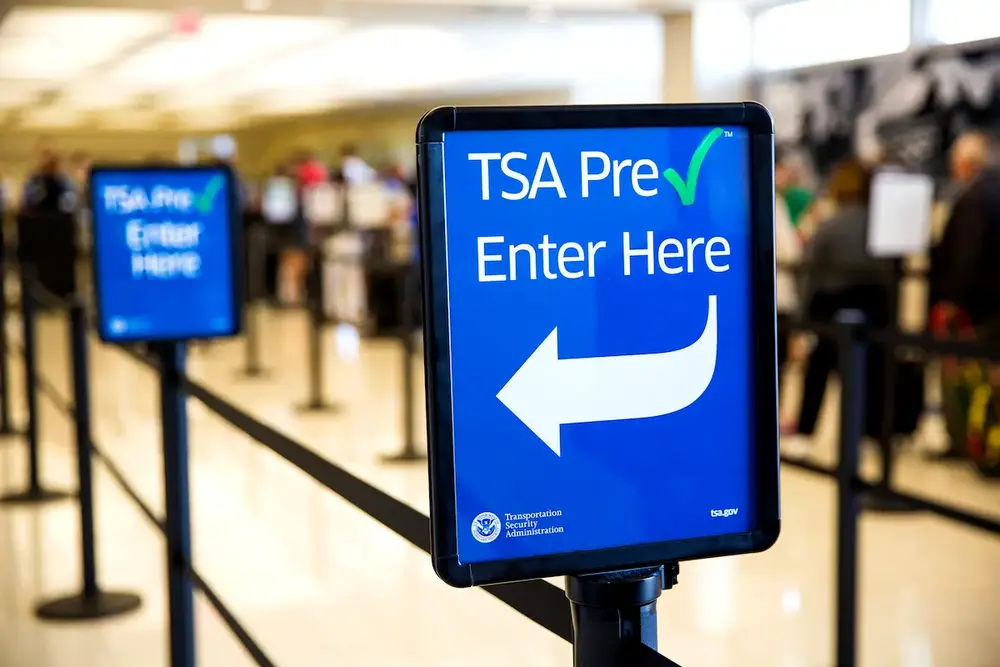
What Is TSA PreCheck?
If you are not much of an international traveler, you might want to consider TSA PreCheck instead. This is a domestic program, so there are no other countries where this would apply. Opened in 2013, TSA PreCheck has over 10 million members throughout the United States.
Benefits
With this program, you’ll be able to keep your shoes, belt, and light jacket on while passing through security. In addition, your laptop and liquids can stay in your bag. This can drastically reduce the time you spend in the screening process. Leave the not-so-good old days of long lines, shoe bins, and dirty airport-floor socks in the past. According to the TSA, 93% of TSA PreCheck members waited less than five minutes.
In addition, finding TSA PreCheck-approved locations is easy. Just check the official TSA map to see if your regular destinations are in the circuit of airports—there are more than 200 participating airports nationwide.
In contrast to Global Entry, if you are traveling with a family, there are fewer restrictions on who can pass with you. Children 12 and under are fine without registering, though you’ll need to get them registered once they turn 13.
Pro-tip: Just like Global Entry, many travel credit cards will reimburse your TSA PreCheck fees!
Disadvantages
As stated before, this is only a domestic program, so it may not be worth the money if you travel internationally as well. Costing $85 for a five-year membership, you are saving $15 dollars in total. Based on your own travel habits, be it international or entirely domestic, you can decide if one option is more worth it than the other.
Similar to Global Entry, there is a multi-step application process:
- Submit your online application and schedule an appointment at an enrollment center
- Have a 10-minute in-person meeting, which includes taking fingerprints for a background check
- Wait for your application to be approved, then use your Known Traveler Number to travel with TSA PreCheck
You will also have to bring some required documents to your appointment. Depending on where you live and your resident status, you may have different requirements. Check on the TSA PreCheck website for more information on your specific situation. Wait time for approval could take between 3-5 days or as long as 90 days.
The Bottom Line on Global Entry and TSA PreCheck
Global Entry may be a better choice for people that often travel internationally and want to expedite their return to the United States. This program also has “entry ports” at different airports around the world, so it can benefit travelers on outbound flights as well.
TSA PreCheck is a domestic program that can only be utilized when traveling within the U.S. Since the five-year membership cost is slightly less expensive than a five-year Global Entry membership, this might be a better choice for someone that knows they won’t be traveling internationally.
Keep in mind that Global Entry includes TSA PreCheck, which means you can get a two-in-one deal for a slightly higher price.
An Overview of Other Popular Trusted Traveler Programs
Global Entry and TSA PreCheck are two of the most well-known Trusted Traveler Programs, but they are not the only programs used by travelers in the U.S. Below, you will learn more about NEXUS and CLEAR, both of which support more efficient traveling experiences.
What Is NEXUS?
This program is designed for people who frequently travel between the United States and Canada. As a joint program between both countries, NEXUS allows you to expedite border clearance for air, land, and sea travel each way.
The original pilot program was initiated in 2000 between the US and Canada. It halted following 9/11, though it would resume the following September as a part of the Smart Border Declaration. Since then, NEXUS has grown to over a million users, including members from both sides of the border (as well as Mexican nationals who are members of the Mexican trusted traveler’s program).
NEXUS Benefits
If you often travel between Canada and the United States, this is directly targeted toward you. At $50, this is the cheapest of the Trusted Traveler Programs alongside FAST. Whether your purpose of visiting is for work, vacation, or visiting family, you can get to your destination (or home) faster with this program.
As with the other Trusted Traveler Programs, your membership lasts for five years. Once you get approved, you’ll be issued a radio frequency ID card that you can use when you travel to either country from the other. There are dedicated processing lanes, as well as access to NEXUS kiosks (in Canada) and Global Entry kiosks (in the United States). One especially nice perk is the ability to report your arrival.
Children under 18 can apply and, if eligible, be admitted without the $50 fee.
Disadvantages of NEXUS
This program only applies to travel between the United States and Canada. If you only really travel between the two, this might be worth it, but if you don’t have a regular reason to cross the border, you’ll have to weigh the worth.
The process is a little more complicated than the other programs as well. Since this is a binational program, both countries need to approve your application. This means the NEXUS application process will look like this:
- Submit an online application and go through the registration process on the TTP site
- Satisfy the eligibility criteria (including being admissible in both the US and Canada)
- Pass risk assessments from both countries—at this point, you will be conditionally approved
- Schedule an interview at a NEXUS center and complete the application process
- Visit a designated center to have your iris captured
What documents you need to have on hand depends on your citizenship status and residency. Check your requirements on either country’s all-encompassing application information sites.
Is CLEAR a Trusted Traveler Program?
No. Though it is approved by the Department of Homeland Security, it is a privately owned company and not one of the DHS Trusted Traveler Programs. It is still a completely acceptable and, in many ways, beneficial program to go with if you decide not to use any of the former options.
With over 12 million members, 40 airports, and hundreds of partners, CLEAR can’t be written off solely because it’s privately owned. In addition to regular CLEAR, there is also the option of CLEAR Plus, which is an airport membership program allowing a faster security experience through designated CLEAR lanes at TSA checkpoints.
CLEAR Benefits
CLEAR operates on biometrics. This means that instead of using a passport, your face or fingerprints can be used in tandem with your boarding pass to get through ID verification. It’s also incredibly easy to sign up, and you can do it right at the airport. Though you’ll need to physically go to a CLEAR center to input your fingerprints, this does not require an appointment. You’ll only need to show up with a government-issued ID.
Price-wise, it may be more expensive than other programs mentioned, but you can also add up to three members of your family to your account for an additional $60 each. This could save money in the long run if your family is older than the designated limit for the other programs, where they would have to register with their own full-price account. Additionally, there are discounts for certain users, such as Delta SkyMiles and United MileagePlus members.
CLEAR Disadvantages
Unfortunately, CLEAR does not come with TSA PreCheck, so unless you purchase it separately, you’ll still need to go through the screening process. Seeing as CLEAR is more expensive than Global Entry (which does already come with TSA PreCheck), you’ll be spending a bit more if you go with this option.
Improving Airport Efficiency
Finding the program that works best for you doesn’t have to be a hassle. Multiple online comparison tools and information sites can help you decide which, if any, would benefit you the most. We at The Parking Spot are here to help make your travel as hassle-free as possible.
For more advice on your travel experiences, download our app or join The Spot Club. You can earn points towards free parking and waived reservation fees. No one likes unnecessary time wasters, especially when you’re traveling. Just as airport security can be tedious and draining, circling parking lots can be incredibly frustrating. Take the next step toward timesaving and book with us today!
More Advice from Travel Tips by The Parking Spot
If you travel for business, take a look at the business travel advice collected from our veteran road warriors. You should also sign up for the Spot Club to be notified of sales and discounts.
- Our travel experts collected a list of the best airports for business travelers.
- Road warriors know how tough it is getting through security and baggage claim. Here are some tips for efficient packing for air travel.
- Loyalty programs, credit card points, and other business travel discount plans contribute to keeping travel budgets in line.
- Even more how to save money on business travel tips and tricks.
- International travelers know TSA plans can help smooth the way through airports.
- What time, day, or month is the best time to fly? Find out now.
- Still more money savingflying hacks. Bon voyage!
Frequently Asked Questions (FAQs)
Q: What is the difference between Global Entry and TSA PreCheck?
A: While both programs are designed to speed up parts of the air travel experience, they serve different purposes:
- TSA PreCheck expedites the security screening process at over 200 U.S. airports. It allows travelers to pass through special lanes where you can keep shoes, belts, and light jackets on, and leave laptops and compliant liquids in your carry-on bag.
- Global Entry is a U.S. Customs and Border Protection (CBP) program that provides expedited customs clearance for pre-approved travelers arriving into the U.S. from international destinations. When returning to the U.S., members can use designated kiosks instead of waiting in traditional customs lines.
Importantly, Global Entry includes TSA PreCheck benefits, so you’ll enjoy both domestic and international travel conveniences under one membership.
Q: How much does each program cost and how long do memberships last?
A: Cost and membership details vary by program.
- TSA PreCheck: The standard application fee is $78 for a five-year membership. Renewals completed online cost $70.
- Global Entry: The application fee is $100 for a five-year membership. This includes TSA PreCheck access.
Both programs require renewal after five years. Some credit cards and loyalty programs offer reimbursement for the application fee.
Q: Can children use TSA PreCheck or Global Entry with their parents?
A: TSA PreCheck and Global Entry rules regarding parents and children sharing membership will vary.
- TSA PreCheck: Children 12 and under can accompany a parent or guardian through the TSA PreCheck lane without having their own membership, as long as the adult has the TSA PreCheck indicator on their boarding pass. Kids aged 13–17 must have their own Known Traveler Number (KTN) or be on the same reservation and also have the PreCheck indicator on their boarding pass.
- Global Entry: Every traveler, regardless of age, must apply for Global Entry separately and complete the enrollment process, including the in-person interview. There are no exceptions for children.
Q: Which enrollment process is faster: TSA PreCheck or Global Entry?
A: TSA PreCheck typically has faster application processing and greater availability of appointment slots. Many enrollment centers are located at airports and in urban areas, and the interview process is usually brief.
Global Entry requires a more in-depth background check, and applicants often wait several weeks to months for a conditional approval and interview. Interviews are available only at select CBP Enrollment Centers, many of which are located in major international airports.
Some Global Entry applicants use “Enrollment on Arrival,” a service that allows travelers to complete their interview at participating airports when returning from international travel. This can significantly reduce the wait time.
Q: If I have Global Entry, do I need to apply separately for TSA PreCheck?
A: No. If you are approved for Global Entry, you automatically receive TSA PreCheck access as part of your membership. You’ll be issued a Known Traveler Number (KTN), which you can enter when booking flights to ensure the TSA PreCheck indicator appears on your boarding pass.
You do not need to submit a separate application or pay an additional fee for TSA PreCheck if you already have Global Entry.
Q: Can Global Entry or TSA PreCheck help when departing the U.S. on an international flight?
A: TSA PreCheck is beneficial when departing the U.S., whether on a domestic or international flight, as long as the airport and airline participate in the program. Travelers can access a faster security lane and avoid removing shoes, belts, laptops, and liquids during screening.
Global Entry, on the other hand, does not affect the departure process. It is used only when returning to the U.S. from an international destination, expediting the customs and immigration process.
Q. How many airports and airlines support TSA PreCheck and Global Entry?
A: The footprint for TSA PreCheck vs. Global Entry differs.
- TSA PreCheck is available at over 200 airports and works with 90+ domestic and international airlines that operate flights from U.S. airports.
- Global Entry kiosks are located at more than 75 international airports, primarily in the U.S., with limited availability at select international preclearance locations like Toronto and Dublin.
Before applying, travelers should verify that their home airport and frequently used airlines participate in the programs for maximum benefit.
Q: Do any credit cards or loyalty programs reimburse the application fee for Global Entry or TSA PreCheck?
A: Yes, many premium travel credit cards offer application fee reimbursements as a cardholder benefit. These include:
- Chase Sapphire Reserve®
- The Platinum Card® from American Express
- Capital One Venture Rewards Credit Card
- Citi® / AAdvantage® Executive World Elite Mastercard®
These cards typically provide a statement credit of up to $100 every 4–5 years to cover the cost of one enrollment fee for either Global Entry or TSA PreCheck. Travelers are encouraged to check with their credit card issuer for eligibility and terms.